Catalog Public API
The Catalog Public API lets you programmatically read and update metadata (tables, columns, dashboards, lineage, quality tests, and more) so you can:
- Automate metadata workflows (sync from external tools, enforce governance rules, keep systems in sync).
- Build custom integrations with internal apps, data products, or orchestration tools.
- Power advanced use cases such as AI assistants, reverse-ETL lineage, or custom reporting.
All endpoints and schemas are documented in our Postman-based reference:
- Full reference: Catalog Public API Playground and Documentation
Authentication and Tokens
The Public API uses a Catalog API token (API secret) for authentication.
- Generate your API token in the API Settings section with the desired scope (Read & Write or Read Only).
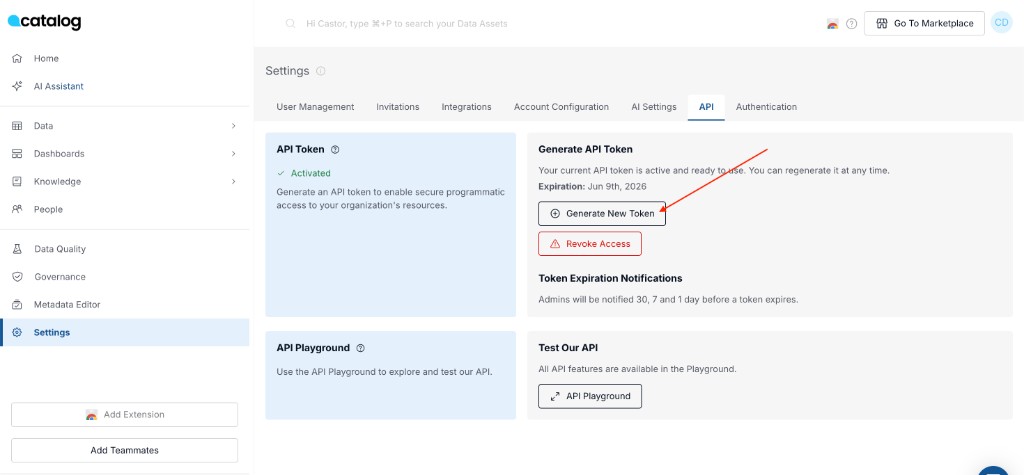
- Use this token:
- In your own scripts / services calling the Public API.
- In the Metadata Importer flows (
BI Importer,Warehouse Importer,Manual Lineage Importer). - In the in-app Catalog API playground (see below) to quickly try requests.
We recommend:
- Treating the token like any other secret (store it in a secrets manager, never commit it to Git).
- Scoping usage to dedicated service accounts where possible.
API Base URLs
Use the base URL that matches your region:
- EU:
https://api.castordoc.com - US:
https://api.us.castordoc.com
In-App Catalog API Playground
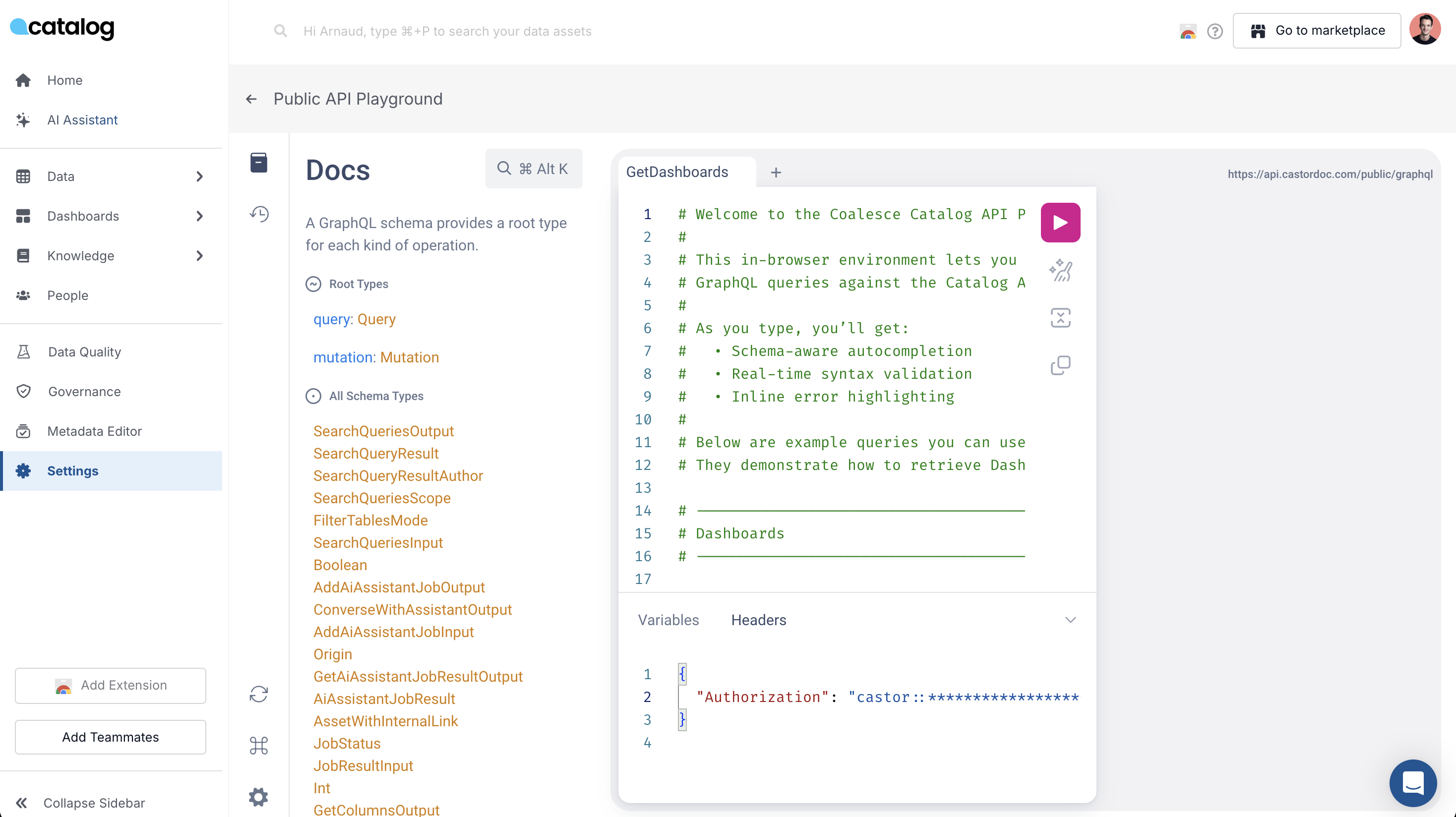
To reduce friction and make it easier to get started, the app includes an in-app Catalog API playground.
With the playground, you can:
- Send real Catalog API requests directly from the product in a safe, guided way.
- Paste your Catalog API token and immediately run live requests against your environment.
- Start from a pre-configured example query that works out of the box—just click Run to see results.
- Use the autocomplete query editor to discover available endpoints and parameters faster (for example, typing
folderssuggests valid folder paths).
This greatly reduces time-to-first-successful-request and helps teams:
- Validate that their token and permissions work.
- Explore the shape of the API before writing any code.
- Quickly prototype new initiatives leveraging the Catalog API.